

What Money Does Hungary Use
Currency of Hungary
| Hungarian forint | |
|---|---|
| Magyar forint(Hungarian) | |
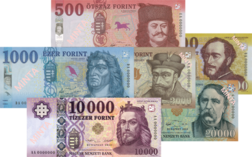 The banknotes of the Hungarian forint | |
| ISO 4217 | |
| Code | HUF |
| Number | 348 |
| Exponent | 2 |
| Denominations | |
| Subunit | |
| 1⁄100 | fillér (defunct) |
| Plural | forintok (nominative only) |
| Symbol | Ft |
| Banknotes | 500 Ft, 1000 Ft, 2000 Ft, 5000 Ft, 10,000 Ft, 20,000 Ft |
| Coins | |
| Freq. used | 5 Ft, 10 Ft, 20 Ft, 50 Ft, 100 Ft, 200 Ft |
| Rarely used | 1 Ft, 2 Ft (defunct) |
| Demographics | |
| Date of introduction | 1 August 1946 |
| User(s) |  Hungary Hungary |
| Issuance | |
| Central bank | Hungarian National Bank |
| Website | www |
| Printer | Pénzjegynyomda Zrt. Budapest |
| Website | www |
| Mint | Hungarian Mint Ltd. |
| Website | www |
| Valuation | |
| Inflation | 2.8% (2018) |
| Source | Trading Economics |
The forint (sign Ft; code HUF) is the currency of Hungary. It was formerly divided into 100 fillér, but fillér coins are no longer in circulation. The introduction of the forint on 1 August 1946 was a crucial step in the post-World War II stabilisation of the Hungarian economy, and the currency remained relatively stable until the 1980s. Transition to a market economy in the early 1990s adversely affected the value of the forint; inflation peaked at 35% in 1991. Since 2001, inflation is in single digits, and the forint has been declared fully convertible.[1] As a member of the European Union, the long-term aim of the Hungarian government may be to replace the forint with the euro, but that does not appear to be likely until some time during the 2020s.[2] [3] [4]
History [edit]
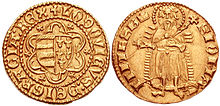
Forint from Louis I of Hungary (1342–1382). Reverse: LODOVICVS DEI GRACIA REX . Obverse: S[ANCTVS] IOHANNES B[APTISTA] .

The forint's name comes from the city of Florence, where gold coins called fiorino d'oro were minted from 1252. In Hungary, florentinus (later forint), also a gold-based currency, was used from 1325 under Charles Robert, with several other countries following Hungary's example.[5]
Between 1868 and 1892 the forint was the name used in Hungarian for the currency of the Austro-Hungarian Empire, known in German as the gulden or florin. It was subdivided into 100 krajczár (krajcár in modern Hungarian orthography).[6]
The forint was reintroduced on 1 August 1946, after the pengő was rendered almost worthless by massive hyperinflation in 1945–46: the highest ever recorded. This was brought about by a mixture of the high demand for reparations from the USSR, Soviet plundering of Hungarian industries, and the holding of Hungary's gold reserves in the United States.[7] The different parties in the government had different plans to solve this problem. To the Independent Smallholders' Party—which had won a large majority in the 1945 Hungarian parliamentary election—as well as the Social Democrats, outside support was essential. However, the Soviet Union and its local supporters in the Hungarian Communist Party were opposed to raising loans in the West, and thus the Communist Party masterminded the procedure using exclusively domestic resources. The Communist plan called for tight limits on personal spending as well as the concentration of existing stocks in state hands.[8]
The forint replaced the pengő at the rate of 1 forint = 4×1029 pengő—dropping 29 zeroes from the old currency. In fact, this was an imaginary exchange rate. With the highest value note being 100 million B. pengő ( 1020 pengő), the total amount of pengő in circulation had a value of less than 0.1 fillér. (The "B" stood for an old-style "billion", i.e. a million million.) Of more significance was the exchange rate to the adópengő of 1 forint = 200 million adópengő.[ citation needed ]
Historically the forint was subdivided into 100 fillér (comparable to a penny), although fillér coins have been rendered useless by inflation and have not been in circulation since 1999. (Since 2000, one forint has typically been worth about half a US cent or slightly less.) The Hungarian abbreviation for forint is Ft, which is written after the number with a space between. The name fillér, the subdivision of all Hungarian currencies since 1925, comes from the German word Vierer which denoted a four-krajcár-piece. The abbreviation for the fillér was f, also written after the number with a space in between.[ citation needed ]
When the forint was introduced, its value was defined on the basis of 1 kilogram of gold being 13 210 forints. Therefore, given that gold was fixed at US$35 per Troy ounce, one USD was at that time worth 11.74 forints.
After its 1946 introduction, the forint remained stable for the following two decades, but started to lose its purchasing power as the state-socialist economic system (Planned economy) lost its competitiveness during the 1970s and 1980s. After the democratic change of 1989–90, the forint saw yearly inflation figures of about 35% for three years, but significant market economy reforms helped stabilize it.
Coins [edit]
In 1946, coins were introduced in denominations of 2, 10, 20 fillérs and 1, 2, 5 forints. The silver 5 forint coin was reissued only in the next year; later it was withdrawn from circulation. 5 and 50 fillérs coins were issued in 1948. In 1967, a 5 forint coin was reintroduced, followed by a 10 forint in 1971 and 20 forint in 1982.
In 1992, a new series of coins was introduced in denominations of 1, 2, 5, 10, 20, 50, 100 and (a somewhat different, 500‰ silver) 200 forint. Production of the 2 and 5 fillér coins ceased in 1992, with all fillér coins withdrawn from circulation by 1999. From 1996, a bicolor 100 forint coin was minted to replace the 1992 version, since the latter was considered too big and ugly, and could easily be mistaken for the 20 forint coin.
Silver 200 forint coins were withdrawn in 1998 (as their nominal value was too low compared to their precious metal content); the 1 and 2 forint coins remained legal tender until 29 February 2008.[9] For cash purchases, the total price is now rounded to the nearest 5 forint (to 0 or to 5).[10] A new 200 forint coin[11] made of base metal alloy was introduced in place of the 200 forint bank note on 15 June 2009.
Banknotes [edit]
In 1946, 10- and 100-forint notes were introduced by the Magyar Nemzeti Bank (Hungarian National Bank). A new series of higher quality banknotes (in denominations of 10, 20 and 100 forints) were introduced in 1947 and 1948. 50-forint notes were added in 1953, 500-forint notes were introduced in 1970, followed by 1,000 forints in 1983, and 5,000 forints in 1991.
A completely redesigned new series of banknotes in denominations of 200, 500, 1,000, 2,000, 5,000, 10,000 and 20,000 forints was introduced gradually between 1997 and 2001. Each banknote depicts a famous Hungarian leader or politician on the obverse and a place or event related to him on the reverse. All of the banknotes are watermarked, contain an embedded vertical security strip and are suitable for visually impaired people. The 1,000 forints and higher denominations are protected by an interwoven holographic security strip. The notes share the common size of 154 mm × 70 mm (6.1 in × 2.8 in). The banknotes are printed by the Hungarian Banknote Printing Corp. in Budapest on paper manufactured by the Diósgyőr Papermill in Miskolc.
Commemorative banknotes have also been issued recently: 1,000- and 2,000-forint notes to commemorate the millennium (in 2000) and a 500-forint note to commemorate the 50th anniversary of the 1956 revolution (in 2006).
Forgery of forint banknotes is not significant. However, forged 20,000-forint notes printed on the paper of 2,000-forint notes after dissolving the original ink might come up and are not easy to recognize. Another denomination preferred by counterfeiters was the 1,000-forint note until improved security features were added in 2006.
Worn banknotes not anymore fit for circulation are withdrawn, destroyed and turned into briquettes which are donated to public benefit (charitable) organizations to be used as heating fuel.[12]
In 2014, a new revised version of the 1997 banknote series was gradually put into circulation beginning with the 10,000 Ft banknote in 2014 and completed with the 500 Ft banknote in 2019.
Current exchange rates [edit]
| Current HUF exchange rates | |
|---|---|
| From Google Finance: | AUD CAD CHF EUR GBP HKD JPY USD |
| From Yahoo! Finance: | AUD CAD CHF EUR GBP HKD JPY USD |
| From XE.com: | AUD CAD CHF EUR GBP HKD JPY USD |
| From OANDA: | AUD CAD CHF EUR GBP HKD JPY USD |
| From fxtop.com: | AUD CAD CHF EUR GBP HKD JPY USD |
Historic rates [edit]
| | This section's wikitables is missing information about the forint's 2018 rates. Please expand the section's wikitables to include this information. Further details may exist on the talk page. (February 2019) |

| Most traded currencies (from 31 December 1990):
Sources: arfolyam.iridium.hu | Currencies of nearby countries (from 31 December 2010):
Sources: arfolyam.iridium.hu The cost of one Euro in forints (from 1999) |


References [edit]
- ^ BBC News Hungary lifts last currency restrictions. 18 June 2001
- ^ "Hungary's New Notes Speak of Late Conversion to Euro". The Wall Street Journal. 1 September 2014. Retrieved 24 May 2015.
- ^ "HUNGARY'S ECONOMY MINISTER SEES POSSIBILITY FOR ADOPTING EURO BY 2020 – UPDATE". Daily News Hungary. 3 June 2015.
- ^ "Hungary mulls euro adoption by 2020". BR-epaper. 19 July 2016.
- ^ Engel, Pál, 1938-2001. (2001). The realm of St. Stephen : a history of medieval Hungary, 895-1526. London: I.B. Tauris. ISBN1-4175-4080-X. OCLC 56676014. CS1 maint: multiple names: authors list (link)
- ^ "A stable currency in search of a stable Empire? The Austro-Hungarian experience of monetary union". History & Policy. 19 April 2017.
- ^ "GLOSSARY". www.rev.hu . Retrieved 10 January 2021.
- ^ "An Attempt at a New, Democratic Start: 1944–1946". The Institute for the History of the 1956 Revolution.
- ^ [1] Archived 21 February 2009 at the Wayback Machine 1 and 2 forint coins were withdrawn from use from 1 March 2008.
- ^ [2] Archived 21 February 2009 at the Wayback Machine The sum of total purchases is rounded
- ^ [3] Archived 4 March 2010 at the Wayback Machine The new 200 forint coin
- ^ Calling for MNB-tender for public benefit organizations (MNB-pályázat közhasznú szervezetek számára)
- Krause, Chester L.; Clifford Mishler (1991). Standard Catalog of World Coins: 1801–1991 (18th ed.). Krause Publications. ISBN0873411501.
- Pick, Albert (1994). Standard Catalog of World Paper Money: General Issues. Colin R. Bruce II and Neil Shafer (editors) (7th ed.). Krause Publications. ISBN0-87341-207-9.
Further reading [edit]
- Gyula Rádóczy; Géza Tasnádi (1992). Magyar papírpénzek 1848–1992 (Hungarian paper money 1848–1992). Danubius Kódex Kiadói Kft. ISBN963-7434-11-9.
- Károly Leányfalusi; Ádám Nagy (1998). Magyarország fém- és papírpénzei 1926–1998 (Coins and paper money of Hungary 1926–1998). Magyar Éremgyűjtők Egyesülete, Budapest. ISBN963-03-6023-3.
- Károly Léányfalusi; Ádám Nagy (2006). Magyarország fém- és papírpénzei 1946–2006 (Coins and paper money of Hungary 1964–2006). Magyar Éremgyűjtők Egyesülete, Budapest. ISBN978-963-7122-16-3.
- Mihály Kupa id. dr. (1993). Corpus notarum pecuniariarum Hungariae I–II. (Magyar Egyetemes Pénzjegytár) (General Hungarian Banknote Catalog). Informatika Történeti Múzeum Alapítvány, Budapest. ISBN963-04-3658-2.
External links [edit]
- Official Daily Exchange Rates Archive, Hungarian National Bank
- (in Hungarian and English) bankjegy.szabadsagharcos.org (Hungarian banknote catalog)
- (in Hungarian and English) www.numismatics.hu (Roman and Hungarian related numismatic site)
- (in Hungarian) papirpenz.hu (pictures of Hungarian banknotes)
- (in Hungarian) Current HUF/EUR and other rates with charts
- (in Hungarian, English, German, and French) www.eremgyujtok.hu (homepage of the Hungarian Coin Collectors' Society)
- Hungarian banknotes (high resolution pictures, also including old forint banknotes)
- Comprehensive catalog of Hungarian coins
- Hungarian National Bank – "Information on forint banknotes and their security features, and forint coins"
| Preceded by: Hungarian pengő Reason: inflation Ratio: 1 forint = 4×1029 pengő | Currency of Hungary 1 August 1946 – Concurrent with: adópengő until 30 September 1946 | Succeeded by: Current |
| Preceded by: Hungarian adópengő Reason: inflation Ratio: 1 forint = 200,000,000 adópengő |
What Money Does Hungary Use
Source: https://en.wikipedia.org/wiki/Hungarian_forint
Posted by: smithbutwousuble.blogspot.com
0 Response to "What Money Does Hungary Use"
Post a Comment